Integration in progress: SCAPE’s IIC and BIC prototypes move from building blocks to complete hardware
SCAPE’s architecture is moving into the integration stage where switching cells, converter legs, cooling hardware, control electronics and mechanical structures must work as one system. WP6, led by IREC, is responsible for turning the project’s building blocks into the converter prototypes that will be used for final validation.
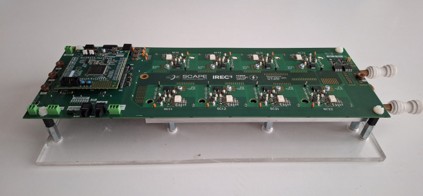
The project is developing two main power-conversion prototypes. The integrated inverter/charger (IIC) combines traction-inverter and onboard-charging functions in a shared architecture. By the June 2026 General Assembly, three converter legs for the IIC had been manufactured and were being tested within validation activities under WP7. The final cold-plate units supplied by DEEP Concept had been assembled and checked for leakage, with all units passing that test. In parallel, the team was developing the mechanical structure that will hold the converter legs and refining the hydraulic circuit that will distribute coolant through the prototype.
This mechanical and thermal integration is not a secondary detail. The converter-leg arrangement has to satisfy electrical, structural and cooling constraints simultaneously. The team is therefore evaluating how the cold plates should be connected hydraulically and using expected junction temperatures together with the operating range of AVL-DE’s pump and test facility to guide the final configuration.
The battery-interfacing converter (BIC) is progressing along a complementary path. The final BIC prototype is based on a multilevel dual-active-bridge DC-DC converter with a 1 kW power rating. Its high-voltage and low-voltage switching cells have been designed, and first samples have been manufactured. The low-voltage cell was verified under resistive-load switching and continuous-conduction operation, while testing of the high-voltage cell was still under way at the June review.
At converter-leg level, the high-voltage baseboard design was complete and the low-voltage baseboard had reached approximately 80% progress. Particular attention is being paid to the interconnection between switching cells, because the physical layout must minimise stray inductance. The transformer for the BIC had also been designed and manufactured. The team is exploring lower-profile assembly options, including flatter heatsinks without fans, to reduce the height of the converter-leg stack.
The final integration stage remains iterative by design. Results from WP7 testing can trigger changes in baseboard layout, auxiliary circuitry, cooling or structure before the remaining units are manufactured. For the IIC, the next activities include completing the structure and cooling system, implementing any layout improvements identified through testing and manufacturing the remaining converter legs. For the BIC, the focus is on completing the baseboards, producing the required switching-cell units and assembling the final converter-leg structure.
This feedback loop between implementation and validation is central to SCAPE’s final phase: it allows the project to transform a modular design concept into complete hardware while still using test evidence to improve the final prototypes.