Digital twins for more robust converter health monitoring
How can an electric-vehicle power converter detect that one of its power switches is beginning to age before the degradation becomes a failure? SCAPE’s WP5 is exploring an answer that combines a physics-based digital twin with machine learning.
The starting point is the behaviour of the SiC MOSFETs used in modern high-efficiency converters. As these devices age, their on-state resistance increases. That change can lead to greater losses and higher junction temperatures, which in turn accelerates degradation. The difficulty is that the resistance is not easy to measure directly during normal operation. Temperature can be measured, but it is also affected by the operating point, transients and sensor noise.
SCAPE’s thermo-electrical digital twin provides a physics-based reference for the expected temperature behaviour of each device. The latest WP5 development adds an LSTM autoencoder to that framework. The autoencoder is trained only with healthy behaviour. In operation, it evaluates the residual between measured temperature and the value predicted by the digital twin. Because it has learned the “manifold” of normal behaviour, a persistent deviation can be treated as a potential degradation signature rather than simply a noisy measurement.
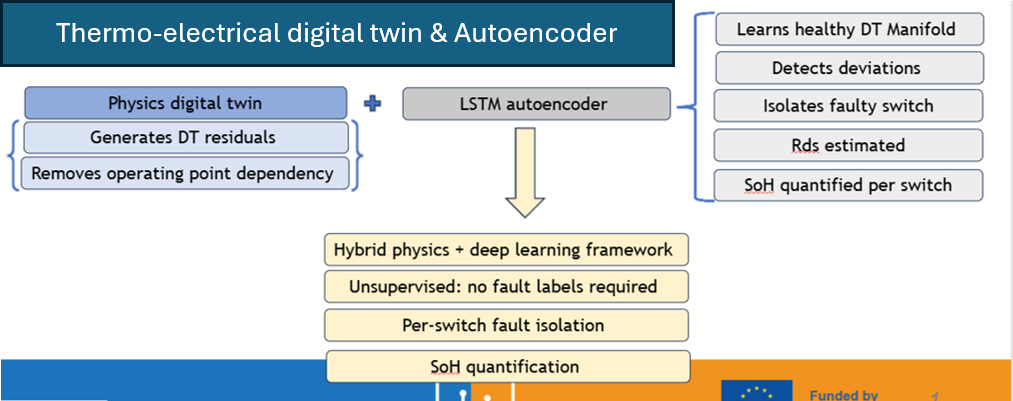
The method has two stages. First, it detects whether the residual pattern is abnormal. Second, it compares the individual switches to isolate which device is most likely to be responsible. The information can then be linked back to the physical model to estimate the change in on-state resistance and quantify a state of health for each switch. Importantly, this is an unsupervised approach: it does not require a large library of labelled fault examples, which would be difficult to obtain for real EV converters.
At the June 2026 General Assembly, the team presented simulation results and a roadmap for the next validation steps. These include final simulations, Hardware-in-the-Loop testing, online implementation, remaining-useful-life estimation and extension from the present model to the six-leg integrated inverter/charger.
WP5 is also advancing the hardware needed to act on health and current information. A half-bridge prototype for active current balancing successfully completed preliminary tests at a 50 V DC link and 5 A with an RL load. Communication, current sensing and temperature sensing were implemented and experimentally verified. The platform is now ready for higher-power testing and for the implementation of dedicated active current-balancing algorithms.
Together, these activities point towards a converter that does more than convert power efficiently. By combining online monitoring, digital twins and adaptive control, SCAPE is working towards power electronics that can understand their own condition and use that information to improve reliability over time.