SCAPE publishes its modular and scalable design guidelines
SCAPE’s modular and scalable power-conversion architecture has reached an important milestone with the submission its Guidelines for the design of modular and scalable EV powertrain architectures.
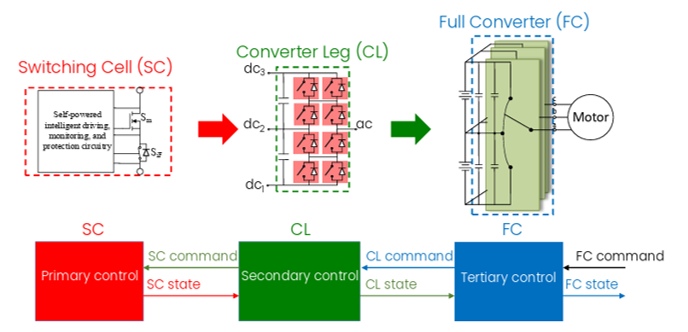
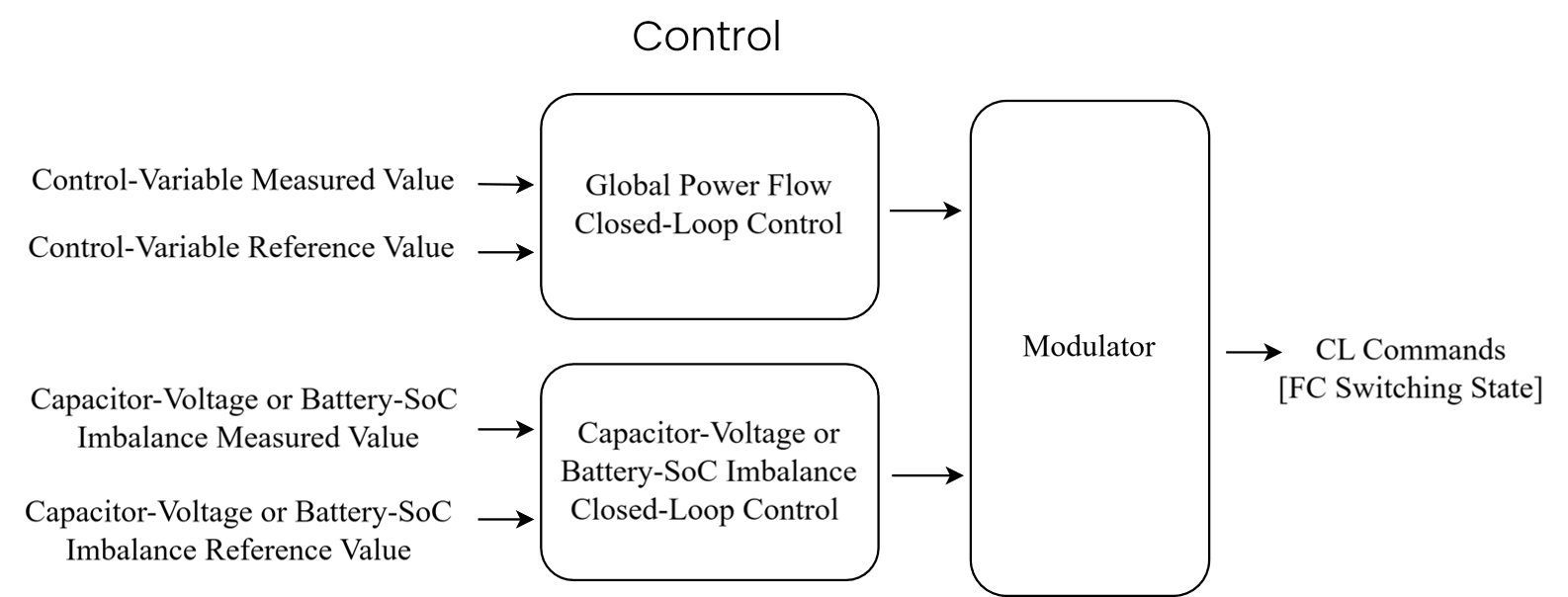
The deliverable brings together the design logic developed during the project and organises it around three hierarchical levels. At the base is the switching cell, a self-contained power-electronics building block. Switching cells are combined into converter legs, and converter legs are then configured into complete converters. Control follows the same hierarchy, with primary functions at switching-cell level, secondary control at converter-leg level and tertiary control at full-converter level.
Why is this useful? Conventional converter design often depends on devices and architectures selected for one specific voltage, current and vehicle application. SCAPE instead investigates a modular approach in which repeated instances of a standard building block can be interconnected to reach the voltage and current ratings required by different electric vehicles. The same design logic can therefore be adapted from smaller vehicles to passenger cars and higher-power applications.
The approach is intended to bring benefits beyond technical scalability. Reusing modules can support economies of scale and reduce the need to redesign every converter from scratch. A modular architecture can also increase configuration flexibility and create opportunities for circularity: individual modules can potentially be replaced, repaired, refurbished or reused rather than treating the complete converter as a single non-serviceable unit.
The guidelines do not stop at the abstract architecture but explore the switching-cell structure and layout, converter-leg configuration and control, strategies for distributing conduction and switching losses, and the full-converter topologies considered in SCAPE. These include the traction inverter, onboard charger, integrated inverter-charger (IIC) and battery-interfacing converter (BIC).
This work has also fed a broader scientific vision. In the IEEE Transactions on Power Electronics paper Quantum Power Electronics – The Ultimate Path for Optimal Power Conversion?, SCAPE researchers and collaborators explore the potential advantages of power-conversion systems built from a single standardised and optimised low-voltage and low-current semiconductor switch. The paper asks how far modularity and standardisation could be pushed if power were processed through increasingly small, repeated switching elements.
With WP3 formally completed, the architecture now provides the reference framework for the project’s remaining implementation and validation work. Further publications are planned on hierarchical control and low-voltage switching-cell layout design.