From Life Cycle Assessment to eco-design: turning environmental evidence into better design choices
How can environmental performance become part of the design process for next-generation EV power electronics?
SCAPE has now completed the Life Cycle Assessment of its inverter, moving from an initial environmental assessment towards a detailed analysis capable of supporting concrete design decisions.
The LCA models more than 130 electronic elements and evaluates environmental performance across 16 impact categories, including climate change, water use, land use and acidification. Particular attention is given to greenhouse-gas emissions, reflecting SCAPE’s wider objective of supporting the decarbonisation of the mobility sector.
Rather than looking at a single configuration, the study explores a range of possible scenarios. These include projected improvements to the SCAPE design, different electricity mixes for 2020 and 2030, and two alternative approaches to inverter integration.
In one configuration, the inverter is integrated around the motor, potentially allowing it to make use of the motor’s cooling system. In the other, the inverter remains independent, with different housing requirements and its own thermal-management solution. The SCAPE solution was also compared with a commercial inverter using first-hand data made available by one of the project partners.
This scenario-based approach allows the team to investigate not only the overall environmental footprint, but also where impacts originate and how they change as the design evolves.
The analysis identifies housing, printed circuit boards and semiconductor components among the main contributors to embodied greenhouse-gas emissions. It also highlights the importance of the use phase: even for highly efficient power electronics, the environmental impact associated with energy losses can vary considerably depending on the electricity mix of the country in which the vehicle operates and on how that mix evolves as energy systems decarbonise.
The assessment therefore provides much more than a final carbon-footprint figure. It helps the consortium understand which technical choices have the greatest environmental consequences — from component selection and PCB area to housing, cooling requirements and converter efficiency.
These findings are now feeding directly into SCAPE’s eco-design work. By combining the LCA hotspot analysis with lessons from the project, relevant literature and sustainable-electronics practices, the team is working to translate environmental evidence into practical guidance for the design of future power converters.
The objective is to create a useful feedback loop: environmental assessment should not only take place once a technology has been developed. Instead, it can inform decisions while materials, packaging, thermal management, architecture and other design parameters can still be optimised.
Some uncertainty inevitably remains. SCAPE is assessing an R&D-stage technology rather than a mature, mass-produced commercial product, meaning that manufacturing processes, component optimisation and real-world operating performance may still evolve. For this reason, the LCA results should be interpreted as scenario-based evidence supporting design decisions rather than as a definitive environmental footprint for a future commercial SCAPE inverter.
Nevertheless, the results show how life-cycle thinking can move from measuring environmental impacts to actively helping reduce them — making sustainability another engineering parameter in the development of tomorrow’s EV power electronics.
Explore the full results in SCAPE’s LCA report on the proposed integrated and scalable power converters
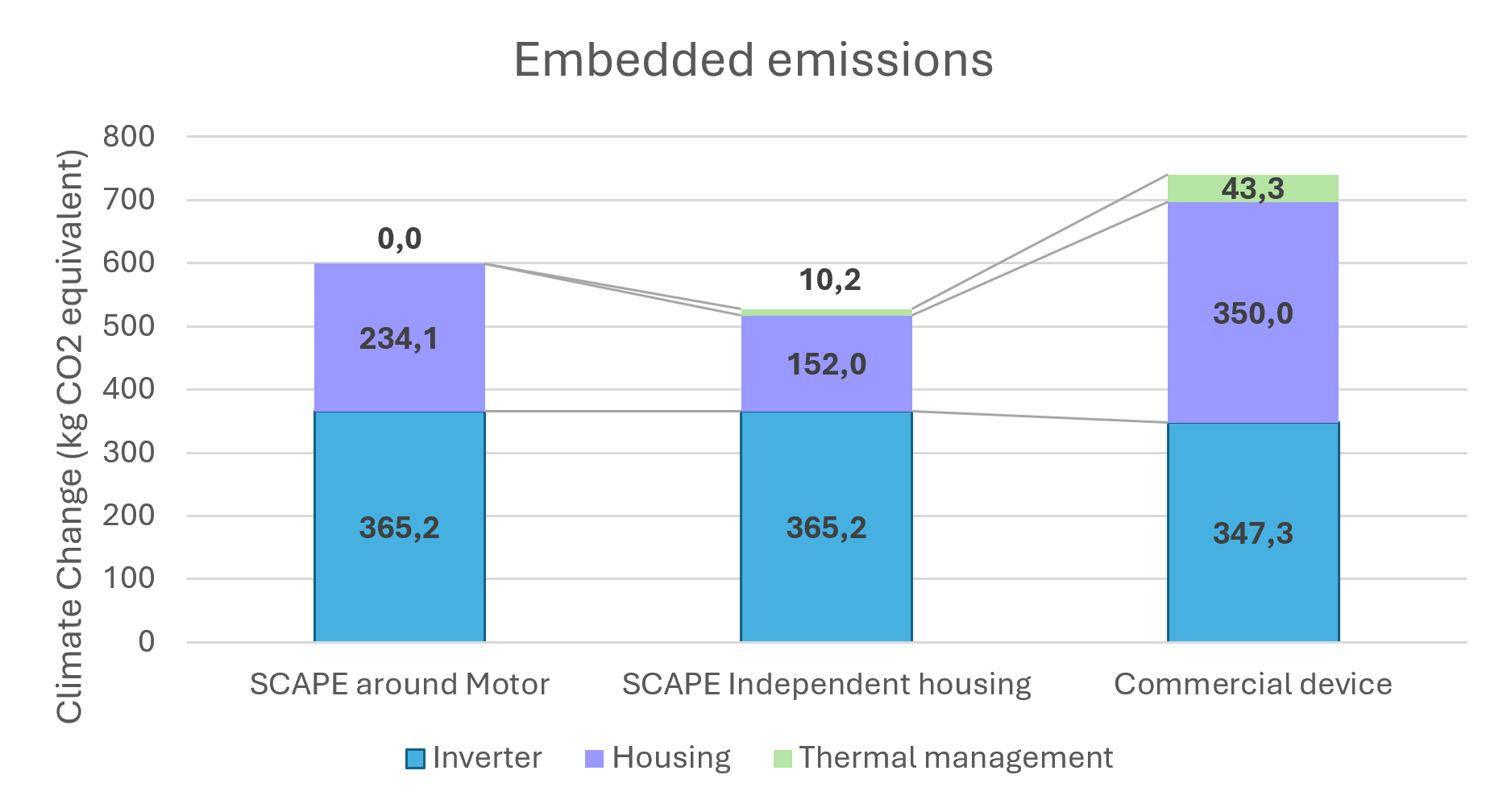
Figure 1. Different results for the inverter designed in SCAPE and considering future improvements, like the reduction of area of the device (affecting the PCB area and the housing requirements) and compared to a commercial device with the same power (100 kW)
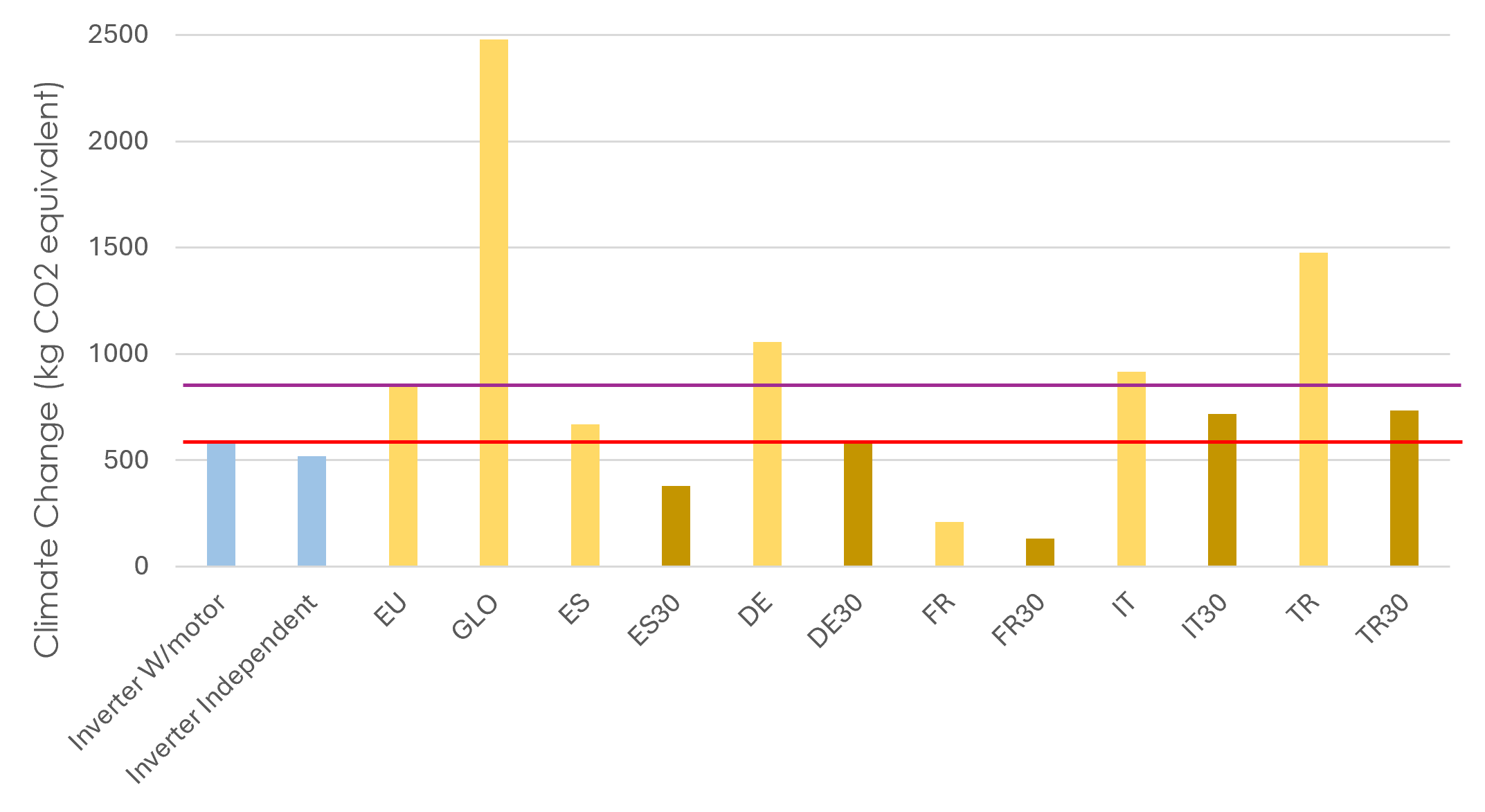
Figure 2. In blue the embodied GHG emissions from the inverter (in its 2 configurations), in light yellow the emissions derived from the use of the inverter in the year 2020 for different countries or regions (in order: Europe, Global, Spain, Germany, France, Italy and Türkiye), and dark yellow the emissions for those same countries but in the year 2030.