From embedded SiC devices to tested hardware: SCAPE advances switching-cell manufacturing and cooling
The chip-embedded high-voltage switching cell is one of SCAPE’s most distinctive hardware developments. By integrating SiC power devices directly into the PCB structure, the project aims to build compact and modular converter building blocks with improved electrical and thermal integration. During the latest implementation phase, WP4 has been working on the practical challenge that follows every promising design: manufacturing enough consistent, tested hardware to assemble and validate the converter.
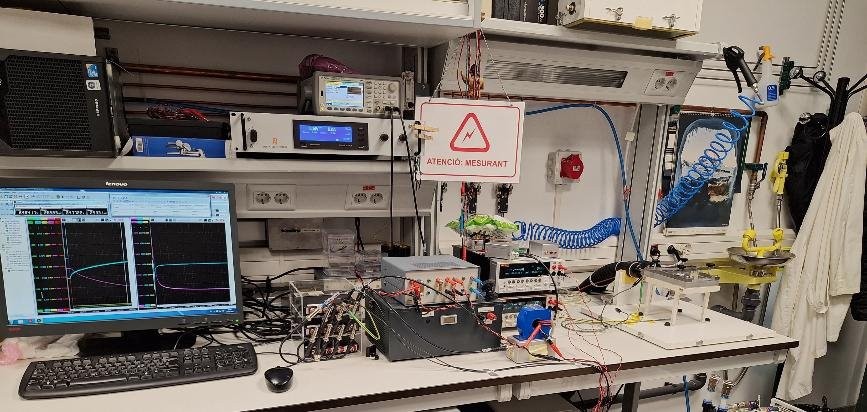
At the June 2026 General Assembly, IMB-CNM-CSIC and DEEP Concept reported that manufacturing of the new PCB batch had been completed with a total of 80 boards produced. At that point, 50 high-voltage switching cells had successfully passed the electrical test sequence and were ready for converter assembly or additional characterisation. Thirteen more boards had localised issues that could be corrected, while a smaller number had more substantial assembly or device problems. The team’s immediate objective was to recover at least five additional functional cells.
The testing process is deliberately progressive. Each cell is checked first at low auxiliary voltages and then through increasing power-terminal voltages and double-pulse tests. This staged approach allows the team to distinguish power-device faults from issues in auxiliary supplies, gate driving, protection circuits or assembly before the cell is integrated into a converter leg.
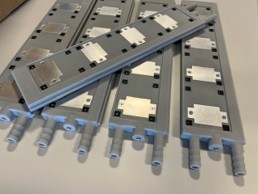
Thermal management has advanced alongside electrical manufacturing. The dedicated team reported an improved junction-to-coolant thermal resistance of approximately 0.95 K/W for the embedded SiC MOSFET configuration at a coolant flow of 8 l/min and a 0.3 bar pressure condition. The final cooling-plate design was also received, and ten cooling plates were assembled. Dedicated hydraulic tests were used to compare pressure drop and temperature rise with the models; in one reported operating range, coolant temperature rise remained below 10 °C at flow rates between roughly 5 and 6 l/min under the test conditions.
The next phase extends the evaluation from functional performance to durability. The team is setting up accelerated thermal-cycling experiments intended to create controlled thermo-mechanical stress in the PCB structure. X-ray and scanning acoustic microscopy are being used as part of the inspection strategy, while COMSOL models are being refined to predict stress and deformation in the embedded structure. The purpose is to identify likely weak points — such as cracks, delamination or interface degradation — and test whether the simulations can reproduce the experimental evidence.
This combination of manufacturing yield, electrical testing, cooling validation and reliability modelling is essential for SCAPE’s final converter work. It provides the bridge between a high-integration packaging concept and hardware that can be assembled, operated and ultimately assessed under realistic converter conditions.