A busy SCAPE week in Modena: from power-electronics teaching to final-phase project decisions
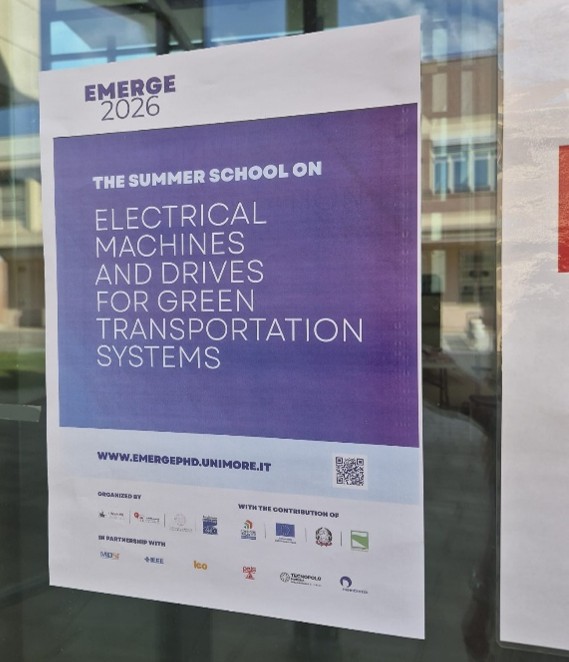
From 8 to 12 June 2026, Modena became a meeting point for advanced electric-mobility research during the 4th EMERGE Summer School on Electrical Machines and Drives for Green Transportation Systems. Organised by the Motor Valley University of Emilia Romagna (MUNER) together with SCAPE partner UNIMORE and IEEE associates, the programme brought together PhD students, early-career researchers and industry engineers for lectures, technical seminars, company visits and networking.
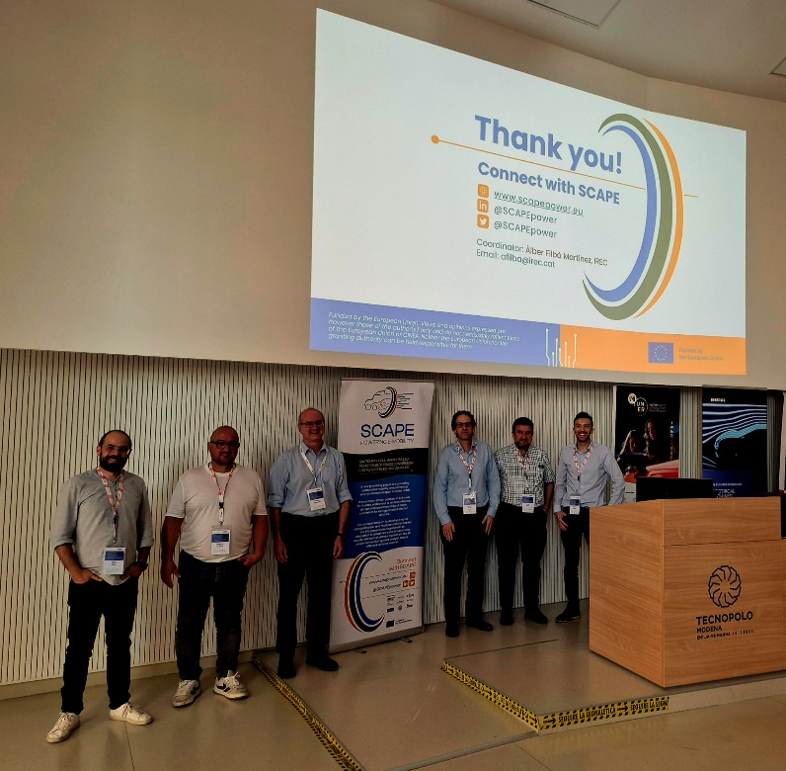
SCAPE contributed a full project-focused day on 9 June. The four lectures were designed to connect the project’s building blocks with the broader engineering choices that shape an electric-vehicle powertrain.
Sebastian Rosado (AVL) presented the process used to design a DC-DC converter for charging a low-voltage EV battery, taking participants from early requirements and topology trade-offs through component sizing, modelling, protection and experimental validation. His presentation highlighted why converter development is an iterative process in which efficiency, thermal management, packaging and component stress must be considered together.
Sergio Busquets-Monge of (Universitat Politècnica de Catalunya – UPC) introduced the fundamentals of multilevel neutral-point-clamped power conversion and showed how those principles underpin SCAPE’s modular and scalable architecture. In the SCAPE approach, switching cells form converter legs, which in turn form complete converters. Reusing and interconnecting these modules offers a route to adapt voltage and current ratings while supporting economies of scale, configuration flexibility and improved circularity through reuse, repair and refurbishment.
Xavier Jordà (IMB-CNM-CSIC) focused on chip-embedding as a route to improved integration of wide-bandgap devices in EV converters. This topic sits at the heart of SCAPE’s hardware work: embedding SiC devices into the PCB is intended to reduce parasitic effects, support compact layouts and improve thermal integration, while demanding careful co-design of materials, interconnections, cooling and manufacturing processes.
Philippe Lasserre (DEEP Concept) completed the day with a packaging perspective. His central message was that there is no universally “best” packaging technology: the right solution depends on application requirements and on the balance between electrical and thermal performance, reliability, manufacturability and cost. For automotive applications, this balance is especially demanding because high power density and high reliability must be achieved at industrial scale and under strong cost pressure.
The week then moved from teaching to project coordination. On 10-11 June, the consortium stayed in Modena for its 7th General Assembly. Partners reviewed progress across the modular power-conversion architecture, converter-leg and switching-cell implementation, advanced controls, digital twins, prognostics and health management, prototype integration, experimental validation, environmental assessment and exploitation. Particular attention was given to the sequence of final tests and to the evidence needed to move from laboratory results towards industry-facing demonstrations and a credible roadmap to market.
The meeting also welcomed SCAPE Advisory Board members Emil Levi, Alessia Focareta and Luca Morfino, whose external perspective supported the discussion on the project’s final technical and exploitation priorities. Together, the Summer School and General Assembly captured two sides of SCAPE’s final phase: sharing the knowledge created by the project while continuing the detailed engineering work needed to validate it.